
Oceans without fish – a potential reality when young fish are overharvested. This is the story of how a campaign to end overfishing implemented innovative strategies to reach millions of unlikely supporters, turn citizens into activists, and change public policy to protect three threatened fish species.
Takeaways
- Many integrated channels. It’s often necessary to use many communications channels to reach new people.
- Humor. Done right, humor can help connect to new and larger audiences.
- Adaptability & Experimentation. Celebrity sex videos, crowdsourced ad funding, virtual pet fish: the campaign was willing to try, innovate, learn and improve on the fly.
- Know how your audiences engages. Mobile and SMS were important because Turkish citizens are already strong mobile users.
For most people, fish are food. Whether line caught or hauled up in a net, these ocean inhabitants are destined for our lunch boxes or dinner tables.
Sadly, there’s little concern for sustainability or appreciation of species inter-dependence. Those with a deeper understanding of the ocean know that even the healthiest populations of commercial fish would soon be decimated if the fishing industry pursued them with indifference to their lifecycle. Today’s fry (baby fish) are tomorrow’s meals — unless they are indiscriminately caught and killed along with mature fish. An alarming fact is that catching these undersized commercial fish is often legal. Catch-size laws even seem geared to allow for what is dismissed as inevitable if un-intended capture of the literal “small fry”.
No big deal to those of us giving our fillets a dollop of tartar sauce, right? But as this fishing philosophy continues, we notice smaller and smaller catches. Nets are netting less because so many fish fail to reach maturity.
We took some time to speak with the GP Med team did to achieve this success, which blended grassroots (or, maybe, oceanbed?) mentality with online and mobile technology. Extra doses of traditional messaging and old-fashioned activism added extra fuel. It’s provided a strong start to fish sustainability awareness and action.

Front of fish ruler used for “How Big is Yours?” campaign.
Part 1 :: Creating a Catchy Campaign — Understanding the Importance of Healthy Oceans
Erhan explains it best: “We had to transfer the perception of fish as food to fish as an integral element of ocean health.” The message was clear. The medium, for Erhan and his team, would be mixed — a smart combination of Internet presence, mobile apps, and traditional broadcast and print.
“Of course we wanted to motivate people to better understand the cause,” noted Erhan, “but we also neeed a strong viral component. The imperative was energizing a large audience. Engagement, and being able to share messaging was essential.”
To the team’s credit, they took the time to thoroughly conceptualize the campaign. “We checked a lot of best-case app successes,” Yigit added. “Farmville, Zenga, even Lady Gaga’s tremendous social media visibility was inspiration.”
The team contemplated the effectiveness of that visibility and impact in terms of both social media platforms themselves, and the significance of the stories being told via these platforms. Both components would prove to be essential to success. Relying on technology alone would mean trendy channels but no content; telling a good story but not pushing it out on the right platforms would mean no one would understand the situation, nor would they be inspired to take action.
Balancing the importance of both social media and the story of undersized fish proved to be the ingredients to a very effective viral campaign, the GP Med team’s Match My Fish mobile application.

Back of fish ruler used in the “How Big is Yours?” campaign.
Part 2 :: Match My Fish — A Direct Line to a Powerful Petition
Built with an engaging interface, as well as strong messaging, Match My Fish provided supporters with a small digital fish, swimming in its own smartphone-sized cyber ocean. The user’s job? Help the fish grow to a fair catch size, one that represented a healthier perspective on sustaining a healthy population.
While Match My Fish delivered a highly viral user experience thanks to its playful theme, the brilliance of the app was that making your virtual fish legal required your sharing the cause with friends.
“Your fish would grow by 0.1 cm per share,” Erhan explained. “And if someone signed our petition to change the Turkish commercial fishing catch-size laws via your link, your fish grew 0.5 cm.”
The sharing awareness also drove app users to a web-based petition targeting Turkish lawmakers. In addition to informing others, app users were influencing politicians.
The cycle proved to be both infectious and effective — fueled by a touch of double entendre. According to Erhan, “the question that set up the share was: ‘I learned how big mine is. Click here to learn how big yours is.” That humorous question proved to be the anchor for the campaign’s identity — and the expression that drove a ton of traffic to the petition site.
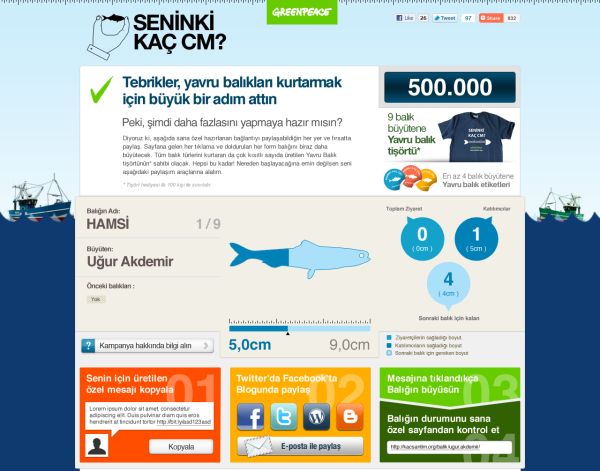
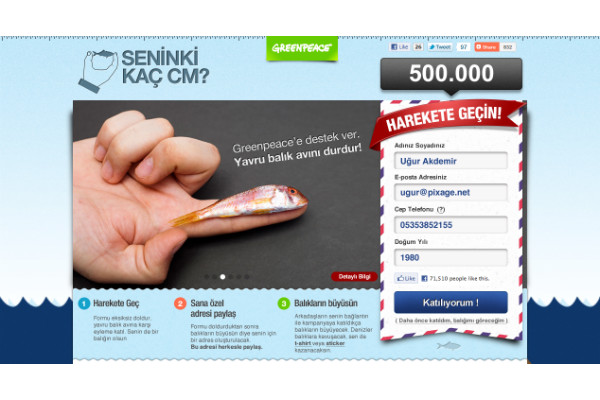
“How Big is Yours?” campaign website that lets citizens match and manage their own fish.
FAX Attack
Along with email, the effort included SMS actions tied to old-school FAX bursts. The team set up a system where someone could go online, choose from a menu of text messages, then hit send. This automatically when to the Ministry of Environment and Agriculture FAX machine. It was incredibly user friendly, with a low effort threshold that resulted in more than 13,000 FAXes being sent to the ministry!
“Sure,” said Yigit, “we caught some criticism from people saying we were Greenpeace and shouldn’t be wasting all that paper, but balanced against the major issue of ocean health? It was definitely worth the trade-off.”
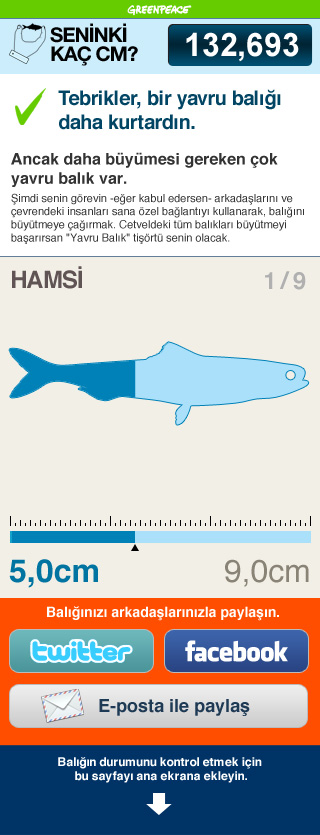
Image of the “How Big is Yours?” mobile app in use.
An Unlikely Advocate
An unintended and ultimately very effective element of the campaign came as the result of ground-level interaction one of it’s youngest participants. While distributing those paper fish rulers at a major fish market, the team encountered a nine-year-old boy who perfectly articulated the thesis. He consented to being photographed and sharing his thoughts, which were beautifully articulated: “I want to eat fish in the future. Stay away from my little fish.”
Making the most of this opportunity meant keeping an open mind. The team needed to be nimble, ready to benefit from situations and messaging that might emerge in the midst of the campaign. Here was a bit of good luck that, thanks to their adaptability, evolved in to a campaign focal point. It became well known in campaign collateral and advertising throughout Turkey.
Part 3 :: Sex Sells (and Saves Fish)
Unafraid of being risque for the sake of their fish, the GP Med team decided to produce a mock “celebrity sex tape” based on campaign themes. Everyone was becoming familiar with the app’s inherently humorous “How Big is Yours” overture. Making a move to the bedroom added just the right amplification.Working with a pair of Turkish television celebrities, they shot a video in a grainy, blurry style that featured the pair languishing in bed. It soon became evident that the couple’s frustrations about “size” were actually about fish.
The video was a huge hit, achieving real love/hate notoriety. It earned more than 5 million views, which was tremendous for issue awareness.
“The big disappointment to the video,” said Erhan, “was that all those views really didn’t translate to petition signatures — the real, actionable objective of the campaign. Still, it was a brave step, and it definitely spread the message.”
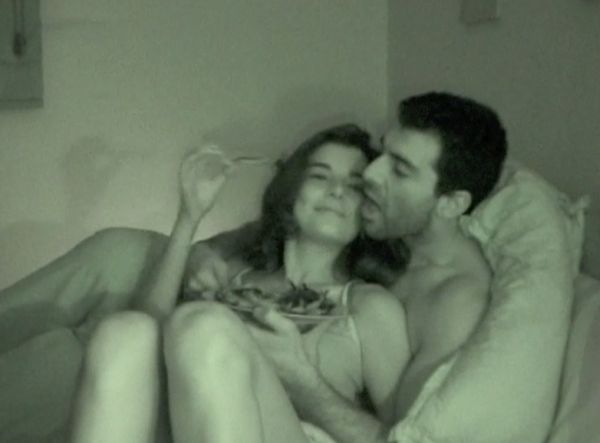
Image from the “How Big is Yours?” sex tape.
Part 4 :: Influencing Lawmakers
The playful, infectious tenor of the campaign was a big hit with the Turkish public. What made it really pack a punch was how every facet was consistently tied back to influencing elected officials. The GP Med team made reaching out to the right elected officials an easy, repeatable process.
As Uygar explained, “our goal was to drum up a lot of in-box and switchboard traffic. To let the people at the right ministries to know that the Turkish public genuinely cared about this issue. All our attention and awareness would be meaningless without action.”
The strategy worked. Because the GP Med team had consistently tied contact action to every aspect of the awareness effort, it was easy for people to call or email elected officials and urge legislative discussion of the nine at-risk fish. It was more than just letting people play on a fun app or whip out their handy fish ruler — it was about empowering informed pressure on legislators.
Several weeks in to the campaign, the team sent an email to its database urging them to keep the pressure up. This phase was implemented to coincide with an upcoming legislative session with the hope that it would get on the agenda.
“The telephone traffic to ministry switchboards was great,” said Erhan. “Two thousand people called in just two weeks, and emails flooded all the right in boxes. After this barrage, the politicians announced they would add undersized fish as an agenda item.”
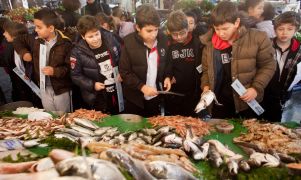
Children at fish market with fish rulers.
Part 5 :: Rest, Then Remind
After the win of getting on the agenda, the GP Med team took a few weeks off to let the issue simmer. That did not mean letting things get too cool, however. By now, online petition signatures were over a half million.
To leverage that participation, the team planned a newspaper action just two days before the legislative meeting. They again appealed to their supporters to help power the campaign, asking people to purchase cheap square centimeter spaces on what would become a massive ad in the major Istanbul news daily. More than 1,500 people bought a square. It was a straightforward play with a straightforward message to lawmakers: We will be watching your decision!
Part 6 :: Frustration, Then Follow-Through
When the ministry met that day, the GP Med team was obviously eager to see progress on the undersized fish issue. Imagine their frustration when, after all their multi-channel, multi-media effort, it was barely mentioned as an agenda item!
“We were upset,” noted Uygar, “but the good news is that our frustration was short lived. That very day, the minister of environment and agriculture called me. He explained that that day’s legislative session was just going to get things started, and that he was definitely willing to work with us.”
Of course, the team wasn’t content to hear those words alone and presume everything was resolved. They launched another phase based on the minster himself simply needing a pen to sign their suggested legislation in to law.
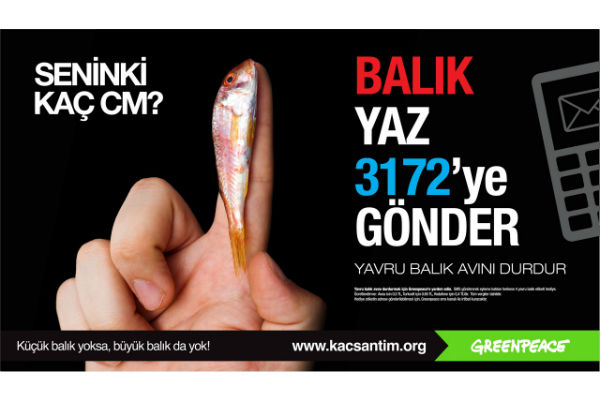
Billboard used to promote using SMS to sign the “How Big is Yours?” petition.
They branded this phase “The Minister Needs a Pen,” and leveraged the campaign’s Facebook presence to spread the word. Fans were invited to upload photos and notes written to the minister. This was coupled to an action request to call the ministry directly urging them not to overlook this issue. To facilitate those calls, GP Med this time created its own switchboard, advertising a fixed line people could call that would immediately transfer them to the ministry of environment and agriculture. It facilitated contact and made it easy for the team to track cause-related call volume.
The email effort was also renewed, with messages to the database reminding them that their fish needed their help. The email frequency increased as the day of the next legislative session drew near, increasing to one every day. This drove traffic to the website (the the campaign’s messaging and take-action cornerstone) and amped up switchboard call traffic, proof that the public was engaging the right political decision-makers.
Two weeks after signing the petition, supporters received an email that said ‘your fish needs you’. Just one week before the meeting we sent an email saying it will be a big week letting people know they would get an email every day.
Part 7 :: The Results
In terms of web traffic, the campaign success meant site visits soared; in the days leading up to the subsequent session, visits were higher than any other GP site in the world. The ministry switchboard was also flooded with calls. And while the technological metrics were impressive, they really speak to the campaign’s true success — engaging the Turkish public on several levels, via several media, to understand the impact commercial fishing could take on catchable fish populations.
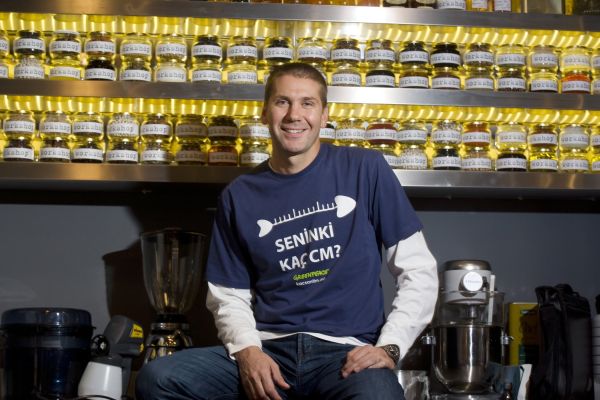
Turkish chef Mehmet Gurs shows support for the “How Big is Yours?” campaign.
The people got it — they understood the immediate concern, and realized that not acting could have devastating consequences for future generations. Ultimately, this campaign was as much about “what’s next” as it was about “what to do now”. That messaging, delivered by a deft combination of traditional and Web-based media, is what’s preserving the commercial fish populations in the Turkish seas.